The Four Forces of Flight
Understand lift, weight, thrust and drag: how each force acts on an aircraft, how they balance in steady flight, and why every manoeuvre changes that balance.
Independent educational resource; not approved flight training. Jonas Aviation is not an approved training organisation, and nothing on this page replaces formal instruction or approved aircraft manuals.
What you will learn
- Define lift, weight, thrust and drag and state the direction each force acts in.
- Explain what it means for the four forces to be in equilibrium in steady, straight flight.
- Describe how changing one force affects airspeed, altitude or aircraft attitude.
- Recognise common beginner misconceptions about how lift is produced.
On this page
Every aircraft in flight is the result of a contest between four forces. Once you can name them, find them on a diagram and say what balances what, most of the rest of beginner aviation theory starts to click. This lesson introduces the four forces, how they act, and what happens when they stop being in balance.
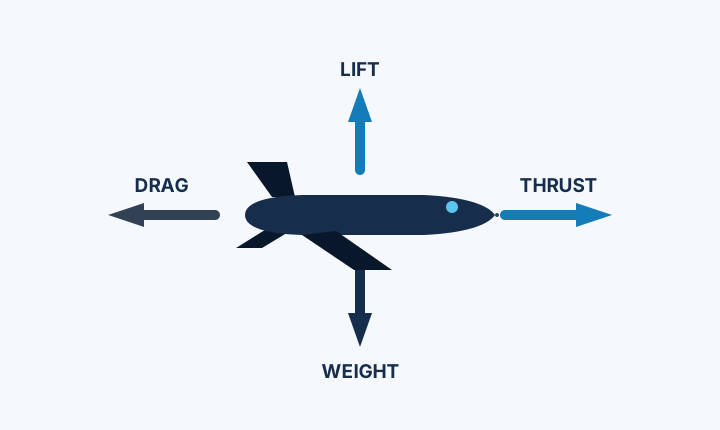
The four forces always appear in pairs: lift balances weight, and thrust balances drag. When the pairs are equal, the aircraft flies straight at a steady speed. When they are not, the aircraft speeds up, slows up, climbs, descends or changes direction.
| Force | Direction | Produced by | Opposes |
|---|---|---|---|
| Lift | Perpendicular to the relative airflow, roughly upward | The wing moving through the air | Weight |
| Weight | Vertically downward, through the centre of gravity | Gravity acting on the aircraft's mass | Lift |
| Thrust | Forward along the flight path | The engine and propeller (or jet) | Drag |
| Drag | Rearward, parallel to the relative airflow | Air resistance acting on the airframe | Thrust |
Lift
Lift is the aerodynamic force that acts perpendicular to the relative airflow, that is, the airflow generated by the aircraft moving through the air. It is produced mainly by the wings and, in straight and level flight, acts upward through a point called the centre of pressure.
How much lift a wing produces depends on four things: air density, wing area, aircraft speed, and the shape and angle of the wing. Engineers compress this into the familiar relationship:
| Symbol | What it means | Typical unit |
|---|---|---|
| Lift produced by the wing | newtons (N) | |
| Density of the air around the wing | kilograms per cubic metre (kg/m³) | |
| Speed of the aircraft through the air | metres per second (m/s) | |
| Surface area of the wing | square metres (m²) | |
| Lift coefficient: how efficiently the wing shape and angle of attack generate lift | none (dimensionless) |
You do not need to memorise the formula to use the idea inside it: speed is squared. Double the speed and the lift the wing can generate roughly quadruples, parasite drag grows by roughly the same factor, and induced drag (see Drag below) falls. Raising the nose increases the wing's angle of attack, which raises the lift coefficient , up to a point, beyond which the wing stalls.
Weight
Weight is the force of gravity pulling the aircraft toward the Earth. It acts vertically downward through the aircraft's centre of gravity, the average location of the aircraft's mass.
Weight is simply mass times the acceleration due to gravity:
So an aircraft with a mass of 1,100 kg has a weight of newtons, which we round to roughly 10.8 kN (kilonewtons). Weight changes during flight: fuel is burned, passengers and baggage differ from one flight to the next, and loading determines where the centre of gravity sits.
Thrust
Thrust is the forward force that drives the aircraft through the air. A propeller produces it by accelerating a tube of air rearward; a jet engine does the same with exhaust gases at higher speed. Either way, the working principle is Newton's third law: push air backward, and the aircraft is pushed forward.
Thrust's job is to overcome drag. When thrust exceeds drag, the aircraft accelerates; when it falls below drag, the aircraft slows down.
Gliders have no engine at all. They replace thrust with a component of their own weight along the flight path: by descending steadily, a glider converts altitude into the forward speed that keeps air flowing over the wings.
Drag
Drag is the aerodynamic force that opposes the aircraft's motion through the air. It acts parallel to the relative airflow, pointing rearward. Pilots usually think of it in two parts:
- Parasite drag comes from everything the air has to flow around: fuselage, struts, landing gear, antennas. It grows rapidly as speed increases (with the square of speed).
- Induced drag is a by-product of producing lift. It is strongest at low speeds and high angles of attack (such as during take-off and landing) and fades as speed increases.
Because one type grows with speed and the other shrinks, total drag is highest at very low and very high speeds, with a sweet spot in between. That is one reason aircraft have a most-economical cruise speed.
When the forces are in balance
Newton's first law tells us that an object keeps doing what it is already doing unless a net force acts on it. In aviation terms: if the aircraft is not accelerating, the four forces must cancel out.
In steady, straight, level flight that means:
- Lift equals weight.
- Thrust equals drag.
Disturb one force and the aircraft responds immediately. Add more thrust than drag and the aircraft accelerates along its flight path. Increase lift above weight and the flight path curves upward. Reduce lift below weight and it curves downward. Every climb, descent and turn begins with one of these imbalances.
Worked example: a light aircraft in level flight
A typical light training aircraft has a mass of 1,100 kg and is flying straight and level at a steady cruising speed. Take as 9.81 m/s² and suppose the total drag in this configuration is 1.3 kN.
- Find the weight. , about 10.8 kN, acting downward.
- Apply the balance condition. Steady, straight, level flight means no acceleration, so lift must equal weight: , acting upward.
- Balance thrust and drag. Steady speed means thrust equals drag: , thrust forward, drag rearward.
- Check the result. Vertical forces: 10.8 kN up − 10.8 kN down = 0. Longitudinal forces: 1.3 kN forward − 1.3 kN rearward = 0. Nothing is left over, so the aircraft keeps flying straight at the same speed, exactly what Newton's first law predicts.
Now suppose the pilot pulls the throttle back to 1.0 kN of thrust. Drag is suddenly larger than thrust, the net force points rearward, and the aircraft decelerates: speed falls, lift falls with it (lift depends on ), and the flight path curves downward unless the pilot pitches up or adds power. One changed force always starts a chain of consequences.
Common misconceptions
"The engine makes the lift." The engine makes thrust. The wing makes lift. A glider with no engine at all flies beautifully on the same four forces; it simply trades height for the relative airflow its wings need.
"Air meeting the wing splits and must rejoin at the trailing edge at the same time." This "equal transit time" story is a widespread teaching shortcut, but it is not correct: the air over the top of the wing arrives at the trailing edge sooner than the air below. Lift is better understood as one picture in two complementary parts: the wing redirects air downward (Newton's third law), and the curved flow over the wing is associated with lower pressure (Bernoulli's principle). Both descriptions are true; the timetable story is not.
"Lift always equals weight." Only in steady, straight, level flight. In a banked level turn lift is greater than weight; in a steady climb its vertical component is slightly less; during a bump or a pull-up the two differ momentarily. "Lift equals weight" is a special case of equilibrium, not a universal rule.
"More power just means more speed, with no side effects." Because drag grows with roughly the square of speed, each extra knot costs progressively more thrust. Push past the design limits and drag, structural loads and fuel burn all climb steeply: the aircraft's published operating limits exist for exactly this reason.
"Banking the wing is what turns the aircraft." Banking is only the setup. Rolling toward the lift vector tilts it sideways; the horizontal component of lift then pulls the aircraft around the turn. The rudder keeps the turn coordinated, but it is the tilted lift vector doing the turning.
Recap
- Four forces act on every aircraft: lift, weight, thrust and drag.
- Lift acts perpendicular to the relative airflow; drag acts parallel to it and rearward.
- Weight is mass × gravity, acting down through the centre of gravity; thrust drives the aircraft forward and must overcome drag.
- In steady, straight, level flight the pairs balance: lift = weight and thrust = drag: no acceleration, no change of state.
- Lift depends on air density, wing area, speed squared and angle of attack, so it changes constantly with flight conditions.
- Every climb, descent, speed change or turn starts with one force deliberately going out of balance, and finishes when a new balance is established.
Sources and further reading
- FAA: Pilot's Handbook of Aeronautical Knowledge (FAA-H-8083-25C), Chapter 5: Aerodynamics of Flight (opens in a new tab)Accessed 9 October 2026
- FAA: Pilot's Handbook of Aeronautical Knowledge (FAA-H-8083-25C), Chapter 4: Principles of Flight (opens in a new tab)Accessed 9 October 2026
- EASA: Easy Access Rules for Aircrew Regulation (EU) No 1178/2011 (opens in a new tab)Accessed 8 October 2026
- NASA Glenn Research Center: Forces in a Climb (opens in a new tab)Accessed 9 October 2026
- NASA Glenn Research Center: Incorrect Lift Theory (the equal transit time story) (opens in a new tab)Accessed 9 October 2026
Last editorial review: 9 October 2026. Authored 8 October 2026.
Knowledge check: The Four Forces of Flight
Answer 6 questions to check what you learned. These are original Jonas Aviation practice questions: not official examination questions, and they grant no credit toward any certificate.
Finished this lesson?
Mark it complete to track your progress through the course on this device.