Aircraft Flight Controls
How the primary flight controls (ailerons, elevator and rudder) move an aircraft around its three axes, and what flaps and spoilers change.
Independent educational resource; not approved flight training. Jonas Aviation is not an approved training organisation, and nothing on this page replaces formal instruction or approved aircraft manuals.
What you will learn
- Name the three axes of an aircraft and the control surface that moves around each one.
- Describe the effect of each primary flight control on the aircraft's motion.
- Explain the purpose of secondary controls such as flaps in take-off and landing.
On this page
An aircraft can rotate in three directions, and every manoeuvre you will ever fly is a combination of them. This lesson introduces the three axes, the primary control surfaces that move the aircraft around each axis (ailerons, elevator and rudder), and the secondary controls (flaps, spoilers and trim) that change how the aircraft behaves rather than which way it points.
The three axes
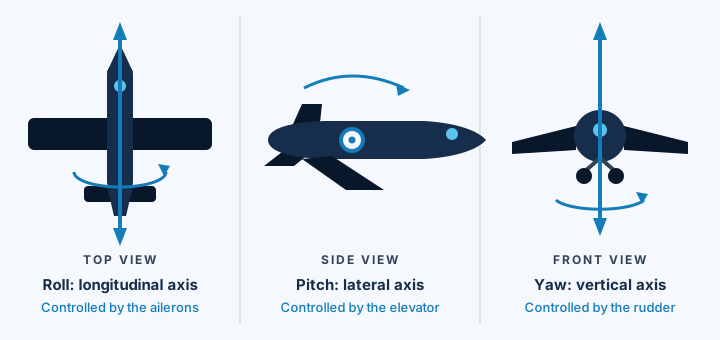
Every aircraft rotates about three imaginary lines that pass through its centre of gravity:
- The longitudinal axis runs from the nose to the tail. Rotation about it is roll.
- The lateral axis runs from wingtip to wingtip. Rotation about it is pitch.
- The vertical axis runs from the top of the aircraft straight down through the wheels. Rotation about it is yaw.
These axes are the vocabulary of control. When an instructor says "you were slow on the pitch axis", or when a checklist says "rudder coordination", everyone is talking about rotation about one of these three lines. A flight is never a single rotation: a climbing right turn, for example, combines a small pitch change, a small roll change and a yaw change at the same time.
Primary flight controls
The three primary controls are the surfaces that produce rotation about the three axes. Each one is a hinged panel that the pilot deflects into the airflow.
| Control | Hinged on | Axis it moves | Effect when the pilot moves it |
|---|---|---|---|
| Ailerons | Trailing edge of each wing, outboard | Roll (longitudinal) | Rolls the aircraft toward the wing that goes down |
| Elevator | Trailing edge of the horizontal tail | Pitch (lateral) | Moves the nose up or down in flight |
| Rudder | Trailing edge of the vertical tail | Yaw (vertical) | Moves the nose left or right in flight |
In most light aircraft the ailerons are moved with the control column, the elevator with the column pushed or pulled, and the rudder with the rudder pedals. The pedals are often linked to the nosewheel steering as well, so they do two jobs: steering at low taxi speed, and yawing the aircraft once there is enough airflow over the rudder.
Two details are worth remembering. First, every control needs moving air to work: an aileron deflected on a parked aircraft changes nothing. Second, controls get more effective as speed increases, because the force a surface can produce grows with dynamic pressure (see the worked example below). That is why the aircraft feels lively at 120 knots and vague at 60 knots, even at the same control deflection.
Secondary flight controls
Secondary controls change the characteristics of the wing or tail rather than the direction of the aircraft:
- Flaps extend from the trailing edge of the wing. When extended, they move downward to increase the lifting force of the wing for take-offs and landings, so the aircraft can fly at a lower speed. Slotted flaps are shaped to maximise the increase in drag while keeping the airflow attached, which is useful on approach, where extra drag lets the aircraft descend steeply without gaining speed. Every aircraft publishes the speeds and flap settings that are permitted in each phase, including a maximum speed with flaps extended.
- Spoilers sit on the upper surface of the wing. They spoil or reduce lift, and they increase drag. Transport aircraft use them as speed brakes in flight, and extend them immediately after touchdown to dump lift so the aircraft's weight transfers onto the wheels for better braking.
- Trim tabs are small movable portions of the trailing edge of a control surface. Trim systems relieve the pilot of the need to maintain constant pressure on the flight controls: a few seconds of trim adjustment replaces minutes of steady pushing or pulling. Balance, servo and antiservo tabs are related devices that lighten or stiffen control forces depending on the design.
A realistic scenario: the gusty first solo take-off
You are lined up on runway 27 in a light training aircraft. The wind is 250 degrees at 14 knots, so there is a crosswind component from your left. The sequence that keeps the aircraft on the centreline combines the controls in exactly the way this lesson describes:
- On the take-off roll you hold full aileron pressure into the wind (left aileron) and keep it there as the aircraft accelerates, until the ailerons become effective and you feel the pressure build.
- You use the rudder pedals to keep the nose on the centreline. At higher speed the rudder itself is doing the work; at very low speed it is the nosewheel steering linked to the pedals.
- As the aircraft lifts off, you neutralise the ailerons gradually, coordinate the pitch with the elevator, and use rudder to hold the heading. The aircraft climbs out straight because all three axes were managed together.
Nothing exotic happens in this scenario: one axis at a time, with the rudder keeping the yaw coordinated and the ailerons countering the crosswind.
Worked example: how speed changes control authority
A control surface works by pushing on air, and the force available grows with dynamic pressure, . At sea level in standard air ( kg/m³):
- Convert speeds to metres per second: 50 kt is about 25.7 m/s, and 100 kt is about 51.4 m/s.
- Dynamic pressure at 50 kt: pascals.
- Dynamic pressure at 100 kt: pascals.
- Compare: . The same aileron deflection at 100 kt produces roughly four times the aerodynamic force it produces at 50 kt.
That single ratio explains three things a student pilot meets early: control forces build with speed, the controls feel mushy at low speed (where you need larger deflections, which increases adverse yaw), and why yanking the column at high speed is punished by large structural loads. It also explains why crosswind aileron pressure increases as the take-off roll accelerates: the same deflection starts biting harder.
Common misconceptions
"The rudder steers the aircraft." The rudder yaws the aircraft in flight by pushing on the airflow, and it works on the take-off roll once there is enough speed. At taxi speeds the nosewheel steering, linked to the same pedals in most trainers, is what actually turns the aircraft on the ground. Steering on the ground and yawing in the air are different jobs that happen to share a pair of pedals.
"Trim means you can let go of the controls entirely." Trim relieves control pressure for the current speed and configuration. Turbulence, gusts and speed changes constantly disturb the trimmed state, and the pilot remains responsible for the aircraft at all times. Trim reduces workload; it does not remove the pilot.
"Flaps are only for landing." Flaps are used for take-offs and landings. Extending them earlier than the handbook allows, or at the wrong speed, changes the aircraft's stall speed and drag in ways the performance calculations did not assume.
"Pressing harder on the aileron gives a cleaner turn." Large aileron deflections at low speed increase adverse yaw, so the nose is pulled away from the turn unless the rudder counters it. A coordinated turn uses smooth, proportionate aileron and matching rudder, not maximum deflection.
"Roll, pitch and yaw happen one after another in a turn." A coordinated turn blends all three: aileron to bank, a little back pressure on the elevator as the vertical component of lift drops, and rudder to keep the nose tracking smoothly around the turn. Coordinated flying is a combination, not a sequence.
Recap
- The three axes are longitudinal (roll), lateral (pitch) and vertical (yaw), all passing through the centre of gravity.
- Ailerons, elevator and rudder are the primary controls, one per axis; each needs airflow to work.
- Adverse yaw makes the nose resist the turn; the rudder counteracts it, most of all at low speeds and large deflections.
- Flaps, spoilers and trim are secondary controls: they change lift, drag and control pressure rather than the direction of the aircraft.
- Control authority grows with the square of speed: doubling speed roughly quadruples the force the same deflection can produce.
- Trim relieves control pressure for one condition only, and coordination means using aileron, rudder and elevator together.
Sources and further reading
- FAA: Pilot's Handbook of Aeronautical Knowledge (FAA-H-8083-25C), Chapter 6: Flight Controls (opens in a new tab)Accessed 9 October 2026
- FAA: Pilot's Handbook of Aeronautical Knowledge (FAA-H-8083-25C), Chapter 3: Aircraft Construction (opens in a new tab)Accessed 9 October 2026
- FAA: Airplane Flying Handbook (FAA-H-8083-3C), Chapter 6: Takeoffs and Departure Climbs (opens in a new tab)Accessed 9 October 2026
Last editorial review: 9 October 2026. Authored 9 October 2026.
Knowledge check: Aircraft Flight Controls
Answer 5 questions to check what you learned. These are original Jonas Aviation practice questions: not official examination questions, and they grant no credit toward any certificate.
Finished this lesson?
Mark it complete to track your progress through the course on this device.