Basic Flight Instruments
The six primary flight instruments, what each one tells the pilot, and how they work together when visibility is limited.
Independent educational resource; not approved flight training. Jonas Aviation is not an approved training organisation, and nothing on this page replaces formal instruction or approved aircraft manuals.
What you will learn
- Identify the six primary flight instruments and the parameter each displays.
- Explain how attitude, altitude and heading information combine for instrument flight.
- Recognise which instrument indications signal a change in aircraft attitude.
On this page
An aircraft's panel is a small set of pressure gauges and spinning gyros that together answer three questions: how fast, how high, how is the aircraft pointed. This lesson introduces the six primary flight instruments, the two physical principles behind them, and how attitude, altitude and heading readings combine when you cannot see the horizon.
Two sensing systems, six instruments
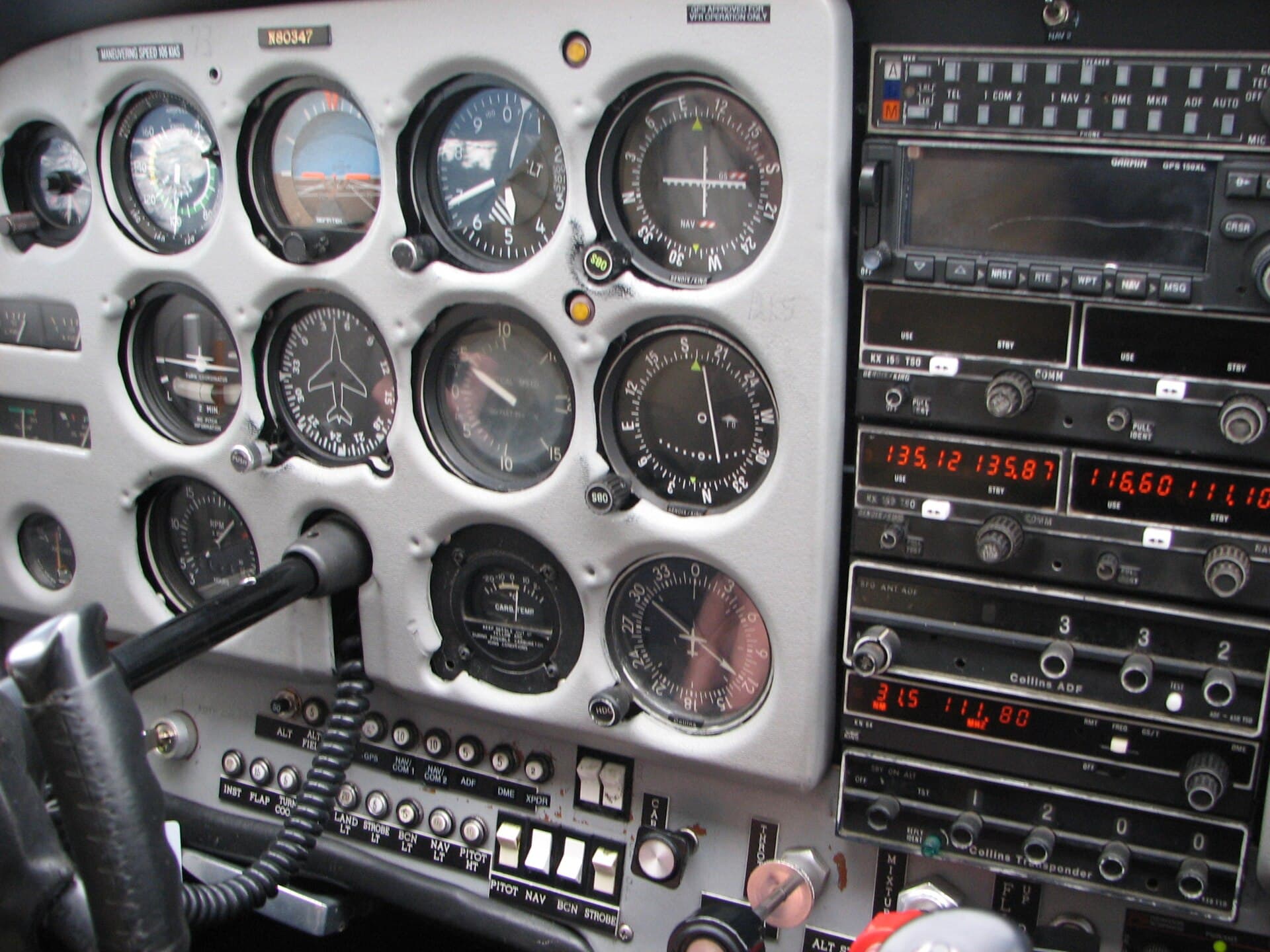
The six instruments pilots learn first (often laid out in two rows of three) split cleanly by what physical quantity they read:
| Instrument | Reads from | What it tells you |
|---|---|---|
| Airspeed indicator (ASI) | Pitot-static system | Dynamic pressure: what the wing and controls are feeling |
| Altimeter | Static pressure | Height above the pressure datum (feet or metres) |
| Vertical speed indicator (VSI) | Static pressure | Rate of climb or descent, in feet per minute |
| Attitude indicator | Gyroscope | Pitch and bank relative to the horizon |
| Heading indicator | Gyroscope | The direction the aircraft's nose points |
| Turn coordinator | Gyroscope (canted) | Rate of roll and rate of turn, plus coordination |
The first three are pitot-static instruments: they work by comparing air pressures, so they only need the pitot tube and static port to be clear. The last three are gyroscopic instruments: they work on a spinning rotor, so they need a power source that keeps the rotor spinning, typically engine-driven suction (vacuum) or electricity.
Pitot-static instruments
The airspeed indicator compares total pressure from the pitot tube with static pressure to display dynamic pressure (see the airspeed lesson for the details). The altimeter is a pressure instrument too: it contains aneroid wafers that expand and contract with static pressure, geared to pointers on the dial (typically a 100-foot pointer, a 1,000-foot pointer and a 10,000-foot pointer). Because it measures pressure, it is really reporting height above a pressure level, which is why you dial in the current altimeter setting; on the ground at an airport, with the local setting set, it reads approximately the field elevation.
The vertical speed indicator also senses static pressure, but as a differential: it compares current static pressure with static pressure from a damped (leaky) reference chamber, so it shows how fast the pressure is changing, not the value itself. Properly calibrated, it reads zero in level flight. It is a rate instrument: it reports the aircraft's climb or descent performance in feet per minute, which is why you use it to check that a climb or descent is going as planned.
Gyroscopic instruments
All practical gyroscopes share two properties: rigidity in space (the spinning rotor keeps pointing the same way while the aircraft moves around it) and precession (a force applied to the rim of the rotor shows up 90 degrees later in the direction of rotation). Every gyro instrument is a clever arrangement of gimbals that translates those two properties into a display:
- The attitude indicator presents an artificial horizon. Because it shows immediate attitude changes, it functions as the control instrument for pitch and bank: it is the instrument you make precise adjustments against.
- The heading indicator rides a gyro-stabilised card so the heading reading does not swing and lag the way a magnet does while you manoeuvre. It shows where the nose points, and the magnetic compass remains the magnetic reference on the panel.
- The turn coordinator uses a canted (tilted) gyro, so it senses both rate of roll and rate of turn. Its index marks the standard rate turn: 3 degrees per second, so a full 360 degree turn at standard rate takes two minutes. Alongside the gyro display sits the inclinometer, the little ball in a curved tube, which shows whether the turn is coordinated (ball centred) or slipping/skidding (ball displaced).
How the instruments work together
Attitude, altitude and heading are the three quantities you fly on when the horizon is not visible:
- Attitude is the primary reference. Pitch and power set the performance; the attitude indicator lets you hold a pitch attitude to within a degree or two.
- Altitude confirms the result. A steady altimeter trend shows whether the chosen attitude and power are producing the climb or descent you want. If the VSI says 500 feet per minute down and the altimeter is unwinding accordingly, the two instruments are telling one consistent story.
- Heading tells you where that attitude is taking you. Holding an attitude without watching the heading is how crosswind drift and lazy turns sneak in.
When the instruments agree, the aircraft is doing what you think it is doing. When they disagree, the disagreement itself is information: check the instruments that share a sensing system (airspeed with altimeter and VSI all read the static/ pitot pressure) against the gyro group before deciding what is real.
Worked example: reading rates as numbers
- A standard-rate turn. The turn coordinator's index marks 3 degrees per second. To turn from heading 090 to heading 180 is a 90 degree change: seconds on the standard-rate index. A full circle takes seconds, the familiar two-minute turn.
- A descent from circuit height. You plan to descend 1,000 feet at 500 feet per minute: minutes of descent, plus whatever you add for the level-off. If the VSI shows only 300 feet per minute, the same height takes minutes, so you are behind profile and a change of pitch or power is needed.
- A climb check. Climbing at 700 feet per minute for two minutes gains feet. If you expected 1,500 and the altimeter shows 1,300 with the VSI steady at 650, the aircraft is performing slightly below the plan, and both instruments agree about it.
A realistic scenario: the hazy turn
On a hazy afternoon the horizon fades and the horizon you can see no longer matches the one outside the window. You enter a shallow turn that is rolled into so gradually that your inner ear stops registering it; after a minute, level flight "feels" like a gentle bank the other way (the classic leans, one of the vestibular illusions described in the FAA's aeromedical guidance). The attitude indicator does not care how it feels: it shows a 20 degree bank, the heading indicator is steady, and the altimeter is holding. Flying the displayed attitude rather than the sensation returns you to straight flight within seconds. If the haze thickens into cloud, the rules change completely: visual flight requires remaining clear of cloud, so the right response is to turn back or land, not to continue into it.
Common misconceptions
"All six instruments work the same way." They do not. Three read air pressure through the pitot-static system and fail with blocked ports; three read gyroscopes and fail with lost spin or power. Knowing which system an instrument belongs to tells you what a failure looks like and which other instruments are likely to be affected with it.
"The heading indicator is a compass." It is a gyro. It is stable and quiet, but it does not sense the Earth's magnetic field, while the panel compass does (with its own induced errors). They are complements, not duplicates: the compass is the magnetic reference, the heading indicator is the manoeuvrable display.
"The VSI tells me how high I am." It tells you how fast the height is changing. The altimeter is the height instrument; the VSI is the performance instrument. Using one for the other's job is how level-offs arrive 400 feet late.
"Instruments matter only when you are in cloud." The attitude indicator is the control instrument for attitude in every phase of flight, in clear air as well. Pilots who only look at it when visibility drops arrive at the moment they need it most without recent practice.
"If the panel and my senses disagree, my senses have a vote." Your senses are not calibrated for flying: the vestibular system does not detect steady rotation and adapts within roughly a minute. The disagreement is the illusion, not the instruments. Where instruments themselves conflict, use the documented instrument checks and the procedures in the handbook.
Recap
- The six primary instruments split into pitot-static (airspeed, altimeter, VSI) and gyroscopic (attitude, heading, turn coordinator) groups with different power needs and failure modes.
- Pressure instruments convert static and dynamic pressure into height and speed; the VSI measures the rate of change, not the value.
- Gyroscopic instruments rely on rigidity in space and precession, and need a continuous power source to keep spinning.
- The turn coordinator's index marks a standard rate turn of 3 degrees per second: two minutes per circle, and 30 seconds for a 90 degree change.
- Attitude, altitude and heading form the cross-checking triangle of instrument flying: hold the attitude, confirm with altitude, track the heading.
- Your senses adapt and mislead; the instruments do not. When they disagree, fly the displayed attitude and check the systems that share each sensing source.
Sources and further reading
- FAA: Pilot's Handbook of Aeronautical Knowledge (FAA-H-8083-25C), Chapter 8: Flight Instruments (opens in a new tab)Accessed 9 October 2026
- FAA: Pilot's Handbook of Aeronautical Knowledge (FAA-H-8083-25C), Chapter 3: Aircraft Construction (opens in a new tab)Accessed 9 October 2026
- FAA: Pilot's Handbook of Aeronautical Knowledge (FAA-H-8083-25C), Chapter 17: Aeromedical Factors (opens in a new tab)Accessed 9 October 2026
Last editorial review: 9 October 2026. Authored 9 October 2026.
Knowledge check: Basic Flight Instruments
Answer 5 questions to check what you learned. These are original Jonas Aviation practice questions: not official examination questions, and they grant no credit toward any certificate.
Finished this lesson?
Mark it complete to track your progress through the course on this device.