Airport and Runway Basics
How runways are named and marked, what the key airport signs and markings mean, and where pilots taxi, take off and park.
Independent educational resource; not approved flight training. Jonas Aviation is not an approved training organisation, and nothing on this page replaces formal instruction or approved aircraft manuals.
What you will learn
- Decode runway designators from magnetic heading.
- Describe the meaning of runway markings and basic airport signs.
- Identify the main areas of an airport used for taxiing, take-off and parking.
On this page
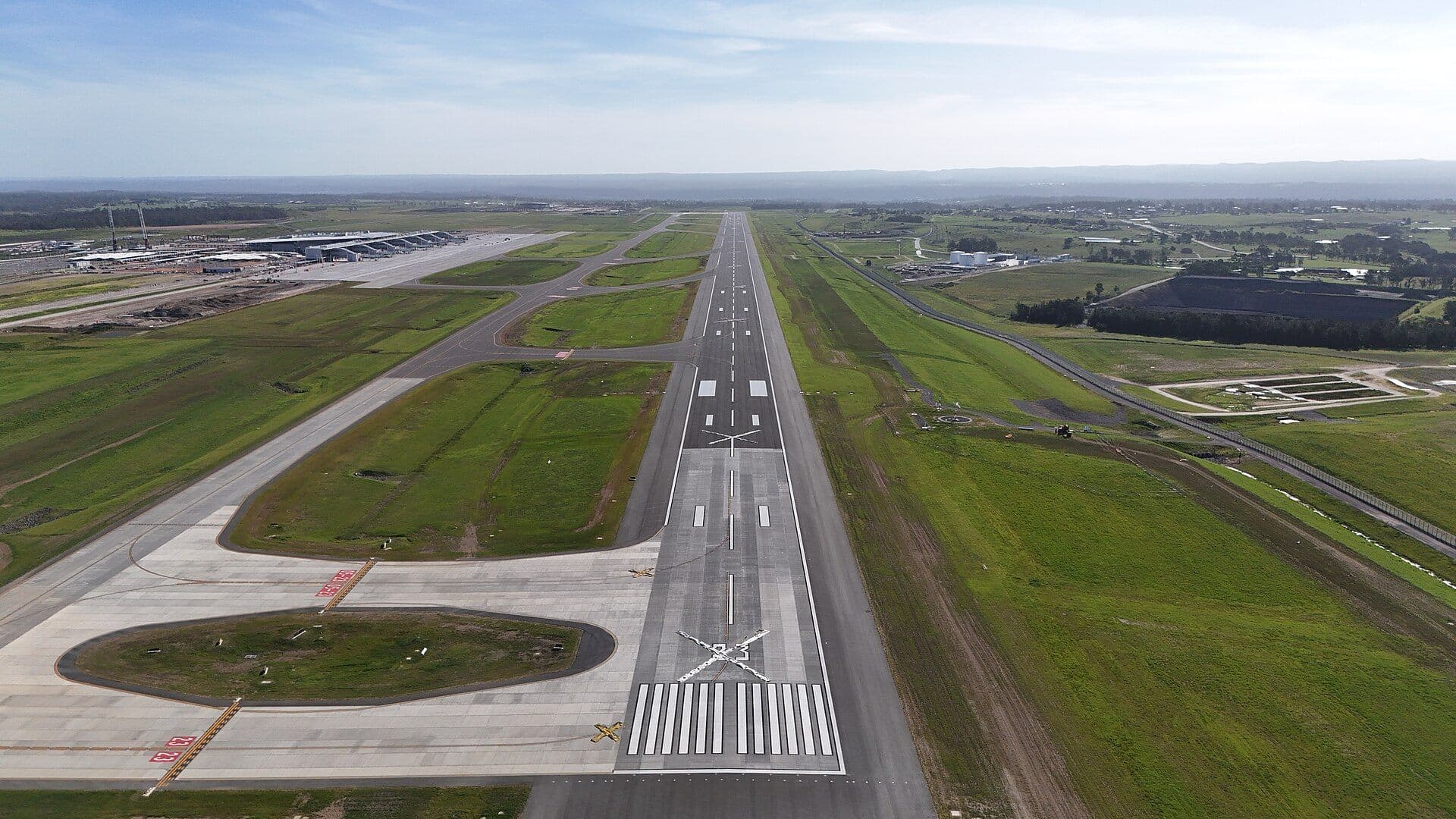
The ground is where most flights spend most of their time, and the painted lines and signs on it are a language of their own. This lesson covers the main areas of an airport, how runways get their numbers and letters, what the standard markings and signs mean, and how wind decides which runway you use.
The three areas: runway, taxiway, apron
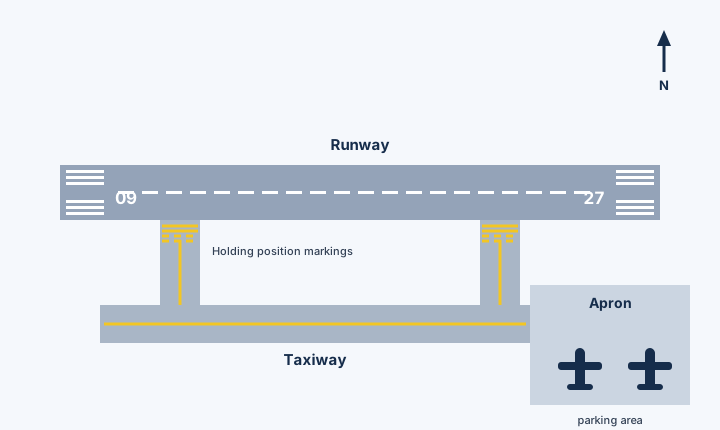
Every airport divides its paved surface into three jobs:
| Area | Job | What you do there |
|---|---|---|
| Runway | Take-offs and landings | Line up, accelerate, land, slow down, exit |
| Taxiway | The connecting routes | Taxi between the apron and the runway end |
| Apron (ramp) | Parking and handling | Load, refuel, park, start up, shut down |
Only the runway is built for flight: it is aligned with the prevailing winds of the area, kept clear, and long enough for the take-off and landing distances aircraft need. Taxiways exist so aircraft can move without occupying a runway, and aprons are where the aircraft stands when it is not moving at all. Treating these as three distinct zones (and the lines between them as real boundaries) is the foundation of safe ground movement.
How runways are named
Runway numbers are not arbitrary labels. The runway number is the whole number nearest one-tenth of the magnetic azimuth of the runway centreline, measured clockwise from magnetic north. In practice:
- Fly or drive the runway direction and read the magnetic compass: a runway pointing (approximately) east has an azimuth of 90 degrees.
- Divide by ten: , written with two digits: 09.
- The same runway from the other end points west: , so it is 27. It is one strip of pavement with two names, and each name is the direction you travel when using it from that end.
Any direction within about 5 degrees of 270 degrees rounds to runway 27, which is why runways are grouped in tens. When an airport has parallel runways in the same direction, the letters L (left), C (center) and R (right) distinguish them: 36L, 36C and 36R are three parallel runways all pointing (approximately) north.
Markings and signs
A basic visual runway may carry nothing but centreline markings and the runway numbers, but the full standard set encodes a surprising amount of information:
- Centreline dashes keep you on the middle of the runway.
- Threshold bars mark the usable beginning of the runway from that direction.
- Runway holding position markings are four yellow lines, two solid and two dashed, painted across the full width of a taxiway where it meets a runway. Seen while approaching the runway, the two solid lines are nearest you: that is the stop line. Seen from the runway side, the dashed pair is nearest you, showing where a departing aircraft may cross back onto the taxiway.
- Signs follow a colour language. A runway holding position sign is effectively an airport stop sign: white characters outlined in black on a red background, always placed with the painted holding marking, and ignoring it can result in a pilot deviation. Taxiway direction signs have a yellow background with black characters naming the intersecting taxiways, with arrows showing which way each one goes. Destination signs show black characters on yellow with an arrow pointing along the taxi route.
- Displaced and relocated thresholds change where the usable runway begins, and runway distance remaining signs count down what is left.
The sign colours exist so that the difference between "you may continue along this taxiway" (yellow) and "you are at a runway boundary" (red) is visible before you can read the words.
Wind decides the runway
The wind report tells you which runway end is into wind. A direct headwind shortens the take-off roll: the aircraft needs less ground speed to achieve flying speed, so it covers less pavement before lift-off. The crosswind component is the part you must counteract with the ailerons and rudder.
Worked example: decoding a wind report
The tower reports: wind 250 degrees at 12 knots. The airport has runways 09 and 27.
- Pick the runway end closest to the wind direction. Wind from 250, runway directions 90 and 270: 250 is 20 degrees away from 270 and 160 degrees away from 90. Use runway 27.
- Split the wind into components. The angle between wind and runway is degrees. Headwind: knots. Crosswind: knots.
- Interpret it. About 11 knots on the nose (a real but ordinary headwind that shortens the roll) and about 4 knots from the left (a modest crosswind, held with aileron into wind and a touch of rudder).
- Check the other end for contrast. Runway 09 would give an 11.3 knot tailwind and the same crosswind, which means a longer take-off roll, more runway used and no benefit. Runways are named for exactly this choice.
A realistic scenario: first solo taxi at an uncontrolled field
You have just taxied out at an airport with no tower. Ahead, a yellow sign with black letters reads B with an arrow: taxiway Bravo leads that way. Further on, a red sign with white letters reads 27 with an arrow, and across the pavement in front of you sit four yellow lines, two solid and two dashed. That combination is the runway holding position: you stop before the solid lines, confirm the runway and the approach path are clear (the wind sock at the runway end shows 250 at about 10, so you are heading for the 27 end), and only then cross. Nothing about this requires radio chatter: the pavement itself carries the instructions, and reading it is a skill you now have.
Common misconceptions
"The numbers are just names like street numbers." They are rounded magnetic headings. Runway 27 points about 270 degrees magnetic, and the two ends of one runway are named for their opposite directions.
"Runway 09 and runway 27 are two runways." They are one runway used from opposite ends. Which end you use depends on the wind, and the naming convention is what lets pilots and controllers say precisely which direction they mean.
"If the taxiway lines say go, you can go." Yellow taxiway guidance does not override the runway boundary. The four-line holding marking (and its red sign) marks the point where you stop and ensure the runway is safe to enter or cross. Runway incursions are among the most common serious ground incidents, which is why every aviation authority drills this line.
"Any runway will do." Runways exist in the orientations the local wind supports. Choosing a runway into the wind shortens the take-off roll and landing distance; choosing the downwind end does the opposite, and the crosswind component always has to be within the aircraft's and pilot's limits.
"Signs and markings are advisory decoration." The colours are a standard language: red means a runway boundary, yellow with black characters guides you between taxiways, and the pavement markings carry the same message for pilots who miss the sign. At busy airports, ignoring them is a pilot deviation, not a style choice.
Recap
- Airports have three paved zones: runway (flight), taxiway (movement), apron (parking).
- Runway numbers are the magnetic azimuth rounded to the nearest tenth (runway 27 is about 270 degrees), with L, C or R distinguishing parallel runways.
- Runways are laid out for the prevailing wind, because taking off and landing into the wind shortens the ground roll.
- Holding position markings are four yellow lines, two solid, two dashed, paired with a red stop-style sign; they are a hard boundary.
- Wind reports decode into headwind and crosswind components with a two-line calculation, and that calculation chooses your runway end.
- The pavement carries the instructions: read the signs, respect the lines, and the airport tells you where to go.
Sources and further reading
- FAA: Pilot's Handbook of Aeronautical Knowledge (FAA-H-8083-25C), Chapter 14: Airport Operations (opens in a new tab)Accessed 9 October 2026
- FAA: Airplane Flying Handbook (FAA-H-8083-3C), Chapter 2: Ground Operations (opens in a new tab)Accessed 9 October 2026
- EASA: Easy Access Rules for Aerodromes (Regulation (EU) No 139/2014) (opens in a new tab)Accessed 9 October 2026
Last editorial review: 9 October 2026. Authored 9 October 2026.
Knowledge check: Airport and Runway Basics
Answer 5 questions to check what you learned. These are original Jonas Aviation practice questions: not official examination questions, and they grant no credit toward any certificate.
Finished this lesson?
Mark it complete to track your progress through the course on this device.